

Marketing Silo vs Connected Growth System: What's the Difference?
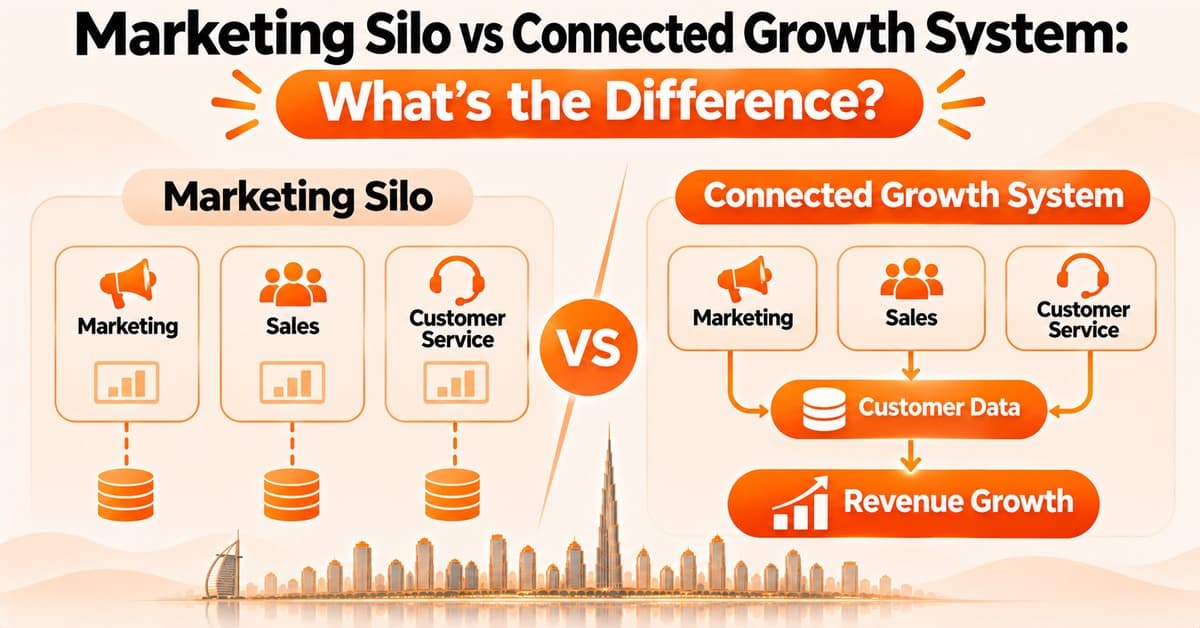
Marketing celebrates record website traffic. Sales says the enquiries are poorly qualified. Lead details sit in another platform, slowing follow-up, while customer objections never reach the people planning campaigns. Every department is busy, but the business struggles to turn activity into revenue.
This is what happens when marketing and growth work in silos. The issue may not be a weak campaign. It may be the lack of a system connecting the work. An integrated growth approach gives teams shared direction, customer context and a practical way to make decisions together.
Introduction
A business can invest in SEO, advertising, social media, website development and automation without creating a coordinated growth process. When functions have separate targets and reports, customers experience the gaps.
The difference between a marketing silo and a connected growth system is not the number of channels used. It is how people, processes, information and decisions work together. A silo measures local activity; a connected system links it to customer progress and business outcomes.
This comparison explains both models, why silos develop and what founders should connect first.
1. What Is a Marketing Silo?
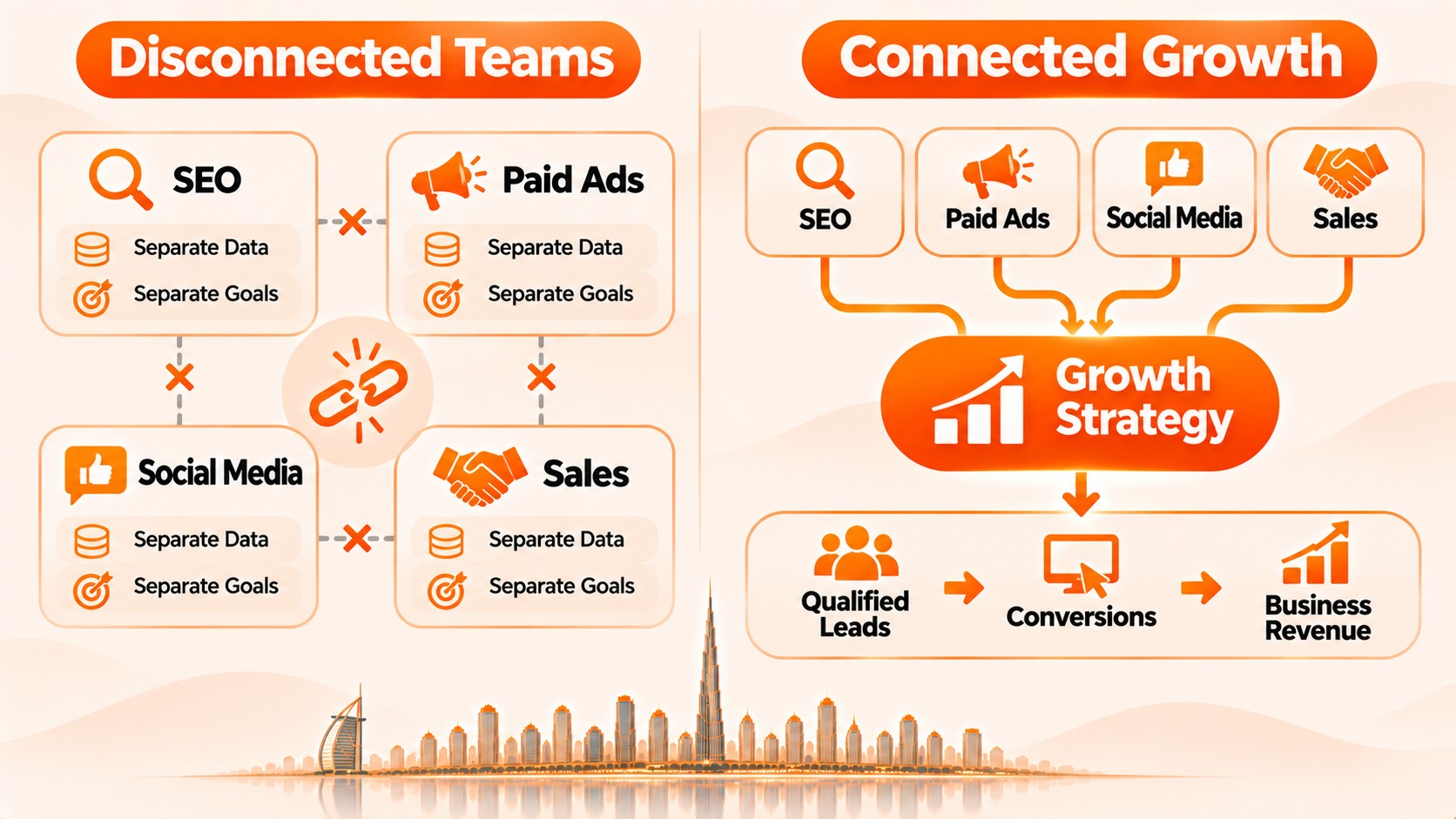
A marketing silo exists when a team, channel or department operates with limited coordination with the rest of the business. SEO may focus on rankings, paid media on clicks, social media on engagement, and sales on closing deals. Each function can report positive numbers while the overall customer journey remains difficult to understand.
Silos do not always come from poor leadership. They often develop as a business grows: specialists are hired one at a time, tools are selected to solve immediate problems, and each function receives its own targets. Over time, teams become accountable for outputs rather than the shared result.
A typical siloed setup may include:
Separate dashboards that use different definitions of a lead, conversion or qualified opportunity.
Campaigns planned without input from sales, service or product teams.
Customer information stored in disconnected tools, spreadsheets and inboxes.
Targets that reward channel activity even when it does not contribute to profitable revenue.
Specialization is useful. The problem begins when responsibility becomes isolation and no one owns the journey from first interaction to repeat purchase.
2. What Is a Connected Growth System?
A connected growth system is an operating approach that aligns business goals, marketing channels, sales activity, customer experience, data and measurement around shared outcomes. It does not require every task to be handled by one team or every tool to be replaced. It requires the important handoffs and feedback loops to work.
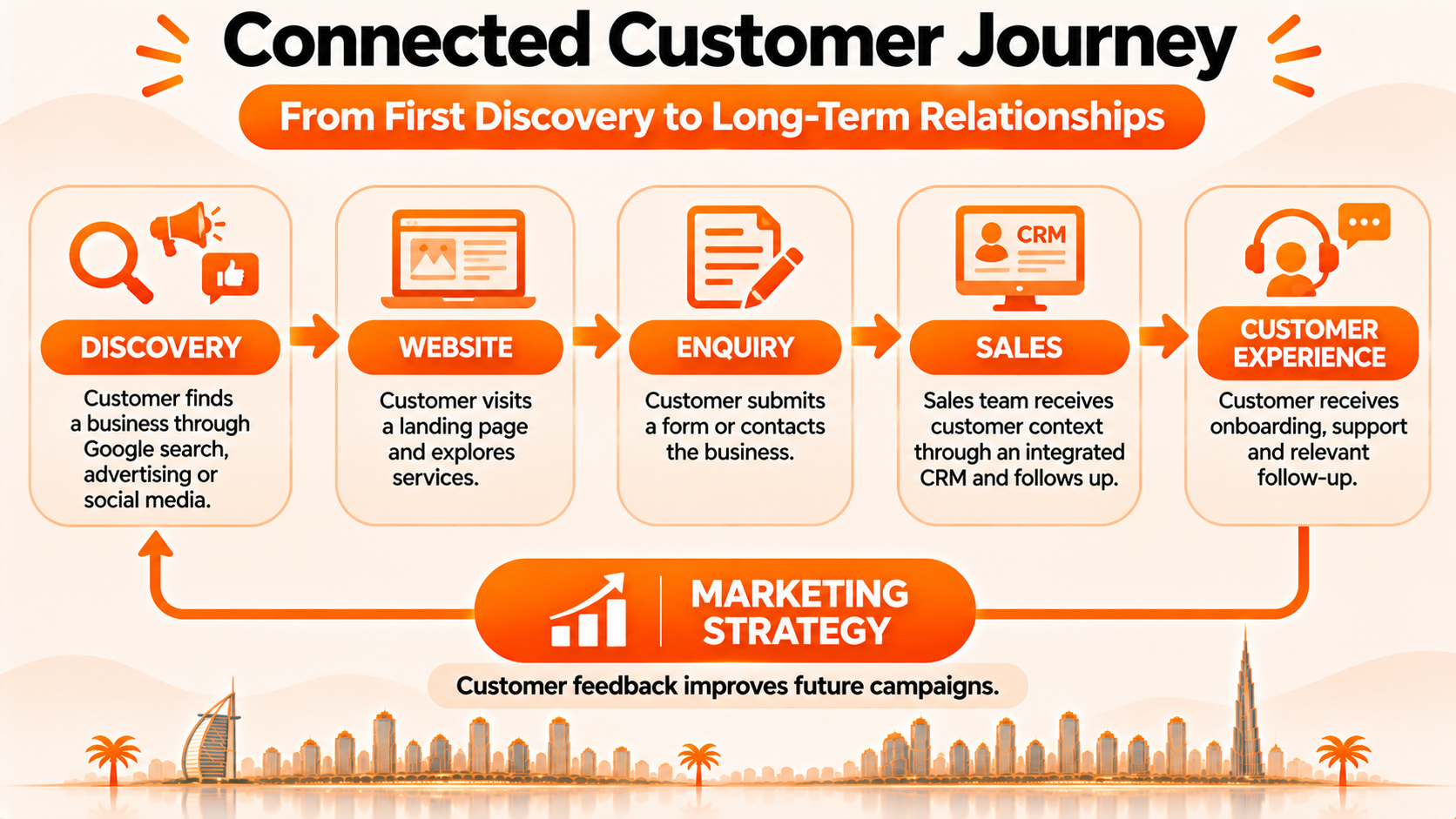
For example, SEO identifies customer questions, content answers them, and the website turns relevant visits into enquiries. A CRM records each lead's source and context. Sales follows up using agreed criteria, then shares outcomes with marketing to improve targeting and offers.
That is integration in practice: each function gives the next one useful information. The goal is not technology for its own sake, but a customer journey the business can manage and improve.
BrandVexo describes this broader approach through its Growth Strategy service, which focuses on connecting channels and decisions rather than treating every activity as a separate purchase.
3. Marketing Silo vs Connected Growth System: The Main Differences
The distinction is clearest in daily decisions.
Area | Marketing silo | Connected growth system |
|---|---|---|
Goals | Each team owns separate activity targets | Teams work toward shared commercial outcomes |
Customer data | Information is scattered across tools | Relevant customer context is accessible across handoffs |
Campaign planning | Channels plan independently | Channel plans support one customer journey |
Lead management | Marketing passes names to sales | Teams agree on qualification, routing and follow-up |
Reporting | Reports focus on channel performance | Reporting connects channel activity to pipeline and revenue |
Customer experience | Messages and follow-up can feel inconsistent | Communication reflects previous interactions |
Decision-making | Teams optimize what they control | Leaders prioritize the biggest constraint across the journey |
Accountability | Success is measured locally | Ownership is clear across the complete process |
Teams can retain specialist metrics. SEO tracks visibility, sales tracks pipeline, and service tracks service quality. Local indicators are interpreted alongside shared outcomes.
4. Why Marketing Silos Hold Businesses Back
Silos first create poor visibility. When campaign data, website behaviour and sales outcomes sit separately, leaders cannot see which activities create qualified opportunities. They may spend more on a channel that produces enquiries but few suitable customers.
They also break handoffs. A prospect may download a guide and visit a pricing page, yet sales receives only a name and phone number. The customer repeats information and the salesperson lacks useful context.
Finally, silos create conflicting priorities. Marketing may be measured on lead volume while sales is measured on revenue. Both teams can hit their targets while the business struggles to grow. Salesforce explains how disconnected data, mismatched KPIs and weak communication can undermine sales and marketing alignment in its guide to sales and marketing alignment.
Silos also create duplicated effort, from overlapping software to repeated reports and content. These costs may not appear in a campaign report, but they consume time and budget.
The wider operating-model challenge is discussed in McKinsey's analysis of connecting for growth. Its central lesson is that structure, ways of working and capabilities need to support the growth agenda. Adding more channels to an unchanged operating model does not automatically create coordination.
5. What a Connected System Changes for the Customer
Customers experience search results, ads, website pages, sales conversations, onboarding and support, not an organisation chart. If touchpoints contradict one another or ignore previous interactions, the company feels disjointed.
A connected model creates continuity: the ad matches the landing page, sales sees what the prospect explored, onboarding understands what was promised, and customer feedback informs future marketing.
Harvard Business Review's article A Better Way to Link Sales and Marketing highlights how siloed customer data can prevent customer-facing teams from accessing synchronized information. The practical point for a growing business is straightforward: a useful customer view is not just a reporting feature. It supports more relevant interactions.
Connection does not mean sending more messages or automating every interaction. It means using existing information responsibly so customers face less friction.
6. The Core Building Blocks of a Connected Growth System
A practical system has five building blocks.
A shared growth direction. Leadership defines the customer segment, offer, commercial objective and constraints. Without this direction, teams can coordinate around the wrong priority.
A mapped customer journey. Document how people discover the offer, evaluate it, enquire, buy, onboard and continue using it. Include service interactions where they influence decisions.
Agreed definitions and ownership. Define what counts as an enquiry, qualified lead, opportunity and customer. Agree who owns each handoff and what happens when information is incomplete.
Connected information and tools. Analytics, CRM, website forms and marketing platforms should share the information needed for decisions. A small business may need a reliable form-to-CRM connection before a complex data warehouse.
A shared review rhythm. Teams review performance, identify the biggest constraint and agree on the next action. A dashboard is useful only when it informs a decision.
These foundations matter more than software. A few well-connected tools and clear ownership can outperform many platforms without a common process.
7. How to Move From Silos to a Connected Growth System
Start with the business problem, not a technology purchase:
Map the current journey. Follow a real customer from first contact to purchase and, where relevant, renewal or referral. Record every channel, team, tool and handoff involved.
Find the most expensive disconnect. Look for repeated data entry, slow follow-up, unclear lead quality, inconsistent messaging or reporting that cannot connect activity to outcomes.
Agree on shared definitions. Decide what a qualified lead means, what information must accompany a handoff and which team owns the next action.
Connect the minimum useful data. Start with the systems needed to preserve source, customer context, status and outcome. Avoid integrating tools that do not support a defined decision.
Set a review cadence. Bring the relevant people together to review the journey, resolve blockers and assign owners. Keep the meeting focused on decisions rather than lengthy status updates.
Test and improve one journey. Choose a high-value segment or service, make a controlled improvement, and compare results with the previous process before expanding the model.
Connecting every platform at once can become a long technology programme. Start where customers experience the greatest friction.
8. A Practical Example: From Disconnected Leads to Shared Revenue
Imagine a professional services company running search ads, publishing articles and receiving website enquiries. Marketing reports traffic and form submissions; sales reports proposals and closed deals. The owner cannot tell which campaign produces valuable customers.
In a siloed setup, marketing increases the budget because submissions are rising, while sales complains that enquiries are poorly matched. The website team may be asked to redesign the form without checking whether the offer or targeting is the real problem.
In an integrated process, campaign source is linked to CRM records, lead qualification, proposal status and revenue. Sales shares objections and disqualification reasons. Marketing uses that feedback to adjust targeting and content, while the website team changes the form only if evidence points to it as a barrier.
The business can now identify which sources create suitable opportunities, where qualified prospects stop progressing and which objections appear most often. Those answers guide decisions across teams.
The company can also review its growth marketing strategy framework to connect acquisition, conversion and retention priorities. For measurement, it can use a consistent set of marketing funnel metrics rather than relying on traffic or lead volume alone.
9. How to Measure Whether the System Is Working
A well-integrated process should clarify performance, not create more dashboards. Choose measures that reflect the business model and customer journey.
Useful measures include:
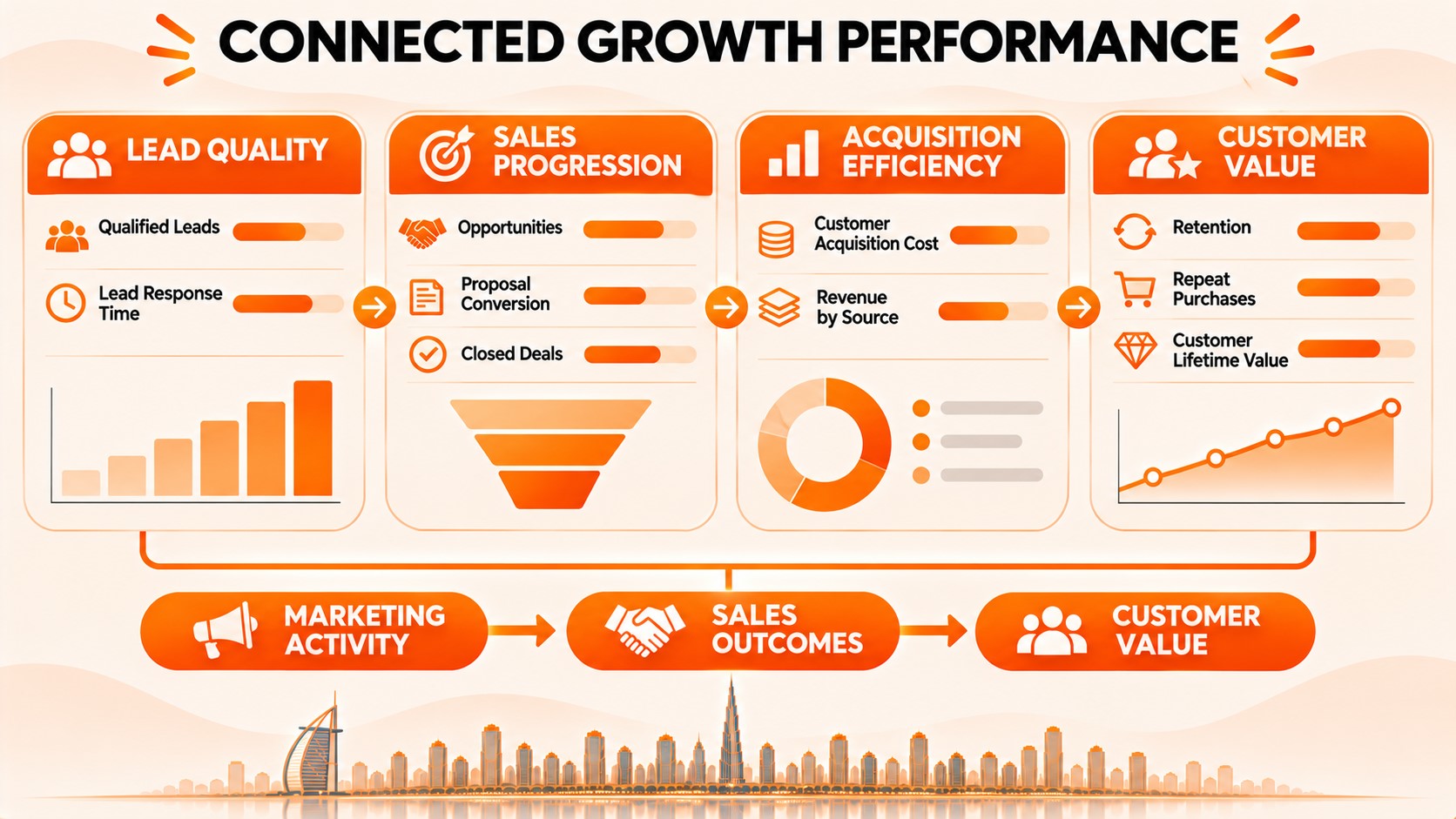
Lead quality: qualified lead rate and lead response time.
Sales progression: opportunity-to-customer conversion and sales cycle length.
Acquisition efficiency: customer acquisition cost and revenue by source.
Customer value: repeat purchase rate and retention.
Not every business needs all of them. Select the few that show whether the system attracts suitable customers and moves them toward a valuable outcome.
Treat channel metrics as diagnostic signals. Fewer organic clicks may indicate a visibility issue; a lower landing page conversion rate may point to a message or experience problem. A low proposal win rate may reflect qualification, pricing or sales execution. A metric tells you where to investigate, not always the cause.
A leadership review should ask: what is the biggest constraint in the customer journey, and what evidence would show that a change helped? This keeps measurement tied to action.
10. When Should a Business Invest in a Connected Growth System?
A connected approach is valuable when a company uses several acquisition channels, has multiple people handling leads, relies on external vendors or cannot explain how marketing contributes to revenue.
Not every business needs an enterprise platform or dedicated growth department. A small company may begin with a shared pipeline, a clear lead definition, source tracking and a weekly review between marketing and sales. The operating model should fit the business's scale.
Before investing, define the problem, decision, process owner and result to measure. If these remain unclear, more software is unlikely to help.
Conclusion
The difference between marketing silos and a connected growth system is the difference between separate activities and coordinated customer and business value. Silos can make teams look productive while hiding gaps between acquisition, sales, delivery and retention. A connected model gives people shared goals, useful customer context, clear handoffs and a review process tied to outcomes. Businesses do not need to connect everything at once. They should fix the most important break in the journey, then build from what they learn.
Request a Growth Audit
Want to see where your growth process is disconnected? BrandVexo can help review your channels, customer journey, website, lead handling and measurement to identify practical improvements. Request a growth audit or consultation to discuss the next step.
Frequently Asked Questions
1. What is the difference between a marketing silo and a connected growth system?
A marketing silo operates independently with separate goals, data and reporting. An integrated model aligns relevant teams, channels, processes and information around shared customer and business outcomes.
2. Does a connected growth system mean every department must report to marketing?
No. It requires coordination and shared accountability, not necessarily a change in reporting lines. Sales, marketing, service and operations can keep their specialist responsibilities while agreeing on common definitions, handoffs and priorities.
3. Is a connected growth system suitable for small businesses?
Yes. Small businesses can start with simple processes such as shared lead records, source tracking, agreed qualification criteria and regular communication between the people responsible for marketing and sales. The system should match the company's size.
4. Which tools are needed to connect marketing and sales?
The basic stack may include website analytics, a CRM, form tracking and marketing platforms. The right tools depend on the decisions the business needs to make. Reliable data flow and clear ownership matter more than the number of tools.
5. How long does it take to move away from marketing silos?
There is no universal timeline. Connecting website enquiries to a CRM may be quick; broader changes to teams, processes and reporting take longer and should be phased.
6. What should a business review first?
Start with one customer journey and trace how information moves from first contact to sale. Identify where data is lost, follow-up slows down, ownership becomes unclear or teams use conflicting definitions. Fix the most commercially important gap first.
Free growth plan
Ready to grow your business?
Reading is a start — now let's build it. Tell us where you want to grow and a senior strategist will map the fastest, most profitable way to get there. Free, no obligation.
Discussion
Join the conversation
Be the first to comment. Comments are reviewed before they appear, so yours won't show up instantly — but we read every one.
Leave a comment
Keep reading
All articles
Digital Transformation Roadmap: A Practical Guide for Growing Clinics
Build a Digital Transformation Roadmap for your growing clinic. Explore essential technologies, implementation steps, automation and patient experience.

Digital Marketing Agency Brief for Clinics: A Practical Guide
Learn how clinics can prepare a digital marketing agency brief, choose the right services, set marketing goals and measure patient acquisition results.

AEO vs GEO vs SEO for Clinics: A Practical Guide to Online Visibility
Understand AEO vs GEO vs SEO for clinics and learn how to improve Google rankings, AI search visibility, and patient acquisition with practical strategies.