

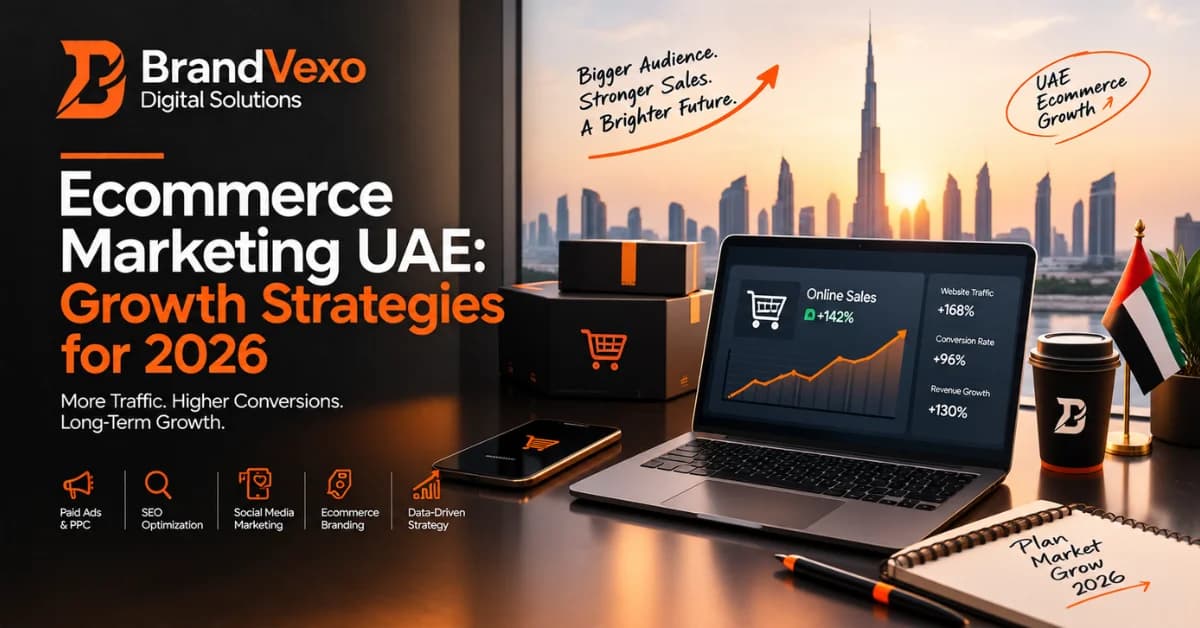
Ecommerce Marketing UAE: Growth Strategies for 2026
The UAE ecommerce market continues to become more competitive as consumers move between search engines, social platforms, marketplaces, websites, and messaging channels before making a purchase. For businesses, this means simply running ads or launching an online store is no longer enough. A connected Ecommerce Marketing UAE strategy needs to attract the right audience, create trust, convert visitors, and encourage repeat purchases.
In 2026, ecommerce brands can strengthen growth by combining SEO, paid advertising, social commerce, AI-assisted personalization, conversion rate optimization, first-party data, and retention marketing. The right mix depends on the product, target audience, margins, competition, and customer journey.
What Is Ecommerce Marketing in the UAE?
Ecommerce marketing is the process of promoting an online store and its products through digital channels to attract potential customers and generate sales. It can include search engine optimization, paid advertising, social media, email marketing, content, influencer campaigns, marketplace marketing, and conversion optimization.
For UAE businesses, the strategy also needs to account for a diverse customer base, mobile shopping, local search behavior, delivery expectations, multilingual audiences, and strong competition between local brands and international retailers.
How Ecommerce Marketing Differs in the UAE
A UAE online store may serve customers from different backgrounds, locations, and purchasing preferences. A customer searching for a product in Dubai may have different expectations from someone browsing the same store from another emirate.
Businesses should therefore consider:
Mobile-first shopping experiences
Clear product and delivery information
Localized landing pages
Multiple payment options
Arabic and English content where appropriate
Fast and transparent delivery information
Customer reviews and trust signals
Social media discovery
Marketplace visibility
The goal is not to create a completely different marketing strategy for every customer. Instead, businesses should identify meaningful audience segments and adapt their messaging accordingly.
Dubai vs Wider UAE Ecommerce Markets
Dubai ecommerce marketing can involve highly competitive search terms, premium product categories, international audiences, tourism-related demand, and a large number of businesses competing for digital visibility.
However, businesses should not treat Dubai as a separate ecommerce universe. Abu Dhabi and other UAE markets can also provide valuable opportunities depending on the product and target audience.
A useful approach is to build campaigns around actual customer data rather than assuming that every UAE consumer has the same purchasing behavior.
UAE Ecommerce Trends Shaping Growth in 2026
The ecommerce landscape is changing quickly. Successful brands need to understand where customers discover products and how they move from interest to purchase.
AI-Powered Ecommerce Marketing
AI can support ecommerce teams across multiple stages of the customer journey.
Businesses can use AI-assisted tools for:
Product recommendations
Customer segmentation
Content ideation
Ad creative variations
Customer-service automation
Predictive analysis
Search and content optimization
Personalized campaigns
However, automation should not replace human review. Product information, claims, pricing, policies, and customer-facing content should remain accurate and useful.
For SEO, businesses should also focus on creating original, helpful information rather than producing large volumes of generic AI-generated pages.
Social Commerce and Short-Form Video
Consumers increasingly encounter products while browsing social platforms. This makes platforms such as Instagram, TikTok, and YouTube valuable parts of an ecommerce marketing funnel.
Brands can use:
Product demonstrations
Customer testimonials
User-generated content
Behind-the-scenes videos
Educational content
Creator collaborations
Short product comparisons
For example, a UAE skincare store could create short videos explaining how different products work, show real customer experiences, and then direct interested users to detailed product pages.
First-Party Data and Privacy-Focused Marketing
Businesses should also build direct relationships with customers rather than depending entirely on advertising platforms.
Useful first-party data can include:
Email subscriptions
Customer purchase history
Product preferences
Consent-based WhatsApp subscriptions
Loyalty activity
Website interactions
This information can help businesses create more relevant campaigns while maintaining appropriate privacy and consent practices.
Omnichannel Ecommerce Experiences
Customers rarely follow a perfectly linear path.
Someone may:
See a product on Instagram.
Search for the brand on Google.
Read reviews.
Visit the website.
Compare prices on a marketplace.
Return through a retargeting ad.
Complete the purchase later.
An effective strategy connects these touchpoints instead of treating every channel as an isolated campaign.
8 Ecommerce Marketing Strategies for UAE Businesses in 2026
1. Build a UAE-Focused Ecommerce SEO Strategy
SEO remains important because customers often begin with a search when they have a specific product need.
An ecommerce SEO strategy should cover:
Product pages
Category pages
Informational content
Long-tail keywords
Internal linking
Image optimization
Technical SEO
Local search where relevant
Product structured data
Instead of creating hundreds of thin pages, focus on useful pages that answer genuine customer questions.
For example, a UAE electronics store could create detailed product pages alongside buying guides, comparison content, compatibility information, and troubleshooting resources.
Google's documentation states that product structured data can help Google understand product information such as price, availability, reviews, and offers.
2. Optimize Your Online Store for Mobile Conversions
A visitor can leave a website within seconds if the experience feels difficult or slow.
Your mobile ecommerce experience should provide:
Fast-loading pages
Clear navigation
Easy product search
Readable product information
High-quality product images
Simple filters
Clear calls to action
Minimal checkout friction
Do not assume that increasing traffic will automatically increase revenue. If visitors struggle to find products or complete checkout, additional traffic can simply increase wasted marketing spend.
3. Use Paid Search and Social Advertising Strategically
Paid advertising can generate faster traffic, but campaigns need clear objectives.
Depending on the business, a marketing mix can include:
Google Search campaigns
Google Shopping
Meta Ads
TikTok advertising
Retargeting
Dynamic product campaigns
Instead of constantly increasing the advertising budget, test different variables such as:
Audience
Creative
Offer
Product
Landing page
Ad copy
A campaign with fewer clicks but higher-quality customers can be more valuable than one that produces large amounts of inexpensive traffic.
4. Turn Social Media Into a Sales Channel
Social media should do more than increase follower numbers.
Use it to answer questions, demonstrate products, establish credibility, and move interested customers toward purchase.
Useful content includes:
Product demonstrations
Customer reviews
Before-and-after explanations where appropriate
Product comparisons
FAQs
UGC
Short educational videos
Creator content
For example, a Dubai fashion brand could show how the same product looks in different settings, explain sizing, answer common customer questions, and direct viewers to the relevant product page.
5. Personalize the Customer Journey
Personalization can make ecommerce communication more relevant.
A store could recommend products based on:
Previous purchases
Browsing behavior
Product categories viewed
Customer segment
Purchase frequency
Location where relevant
For example, a customer who previously purchased a specific skincare product could receive information about compatible products or replenishment options.
The key is relevance. Personalization should make shopping easier rather than make customers feel monitored.
6. Strengthen WhatsApp, Email and Retention Marketing
Acquiring a new customer can require significant marketing investment. Retention therefore deserves a place in the ecommerce strategy.
Useful campaigns include:
Welcome emails
Abandoned-cart reminders
Product education
Post-purchase follow-ups
Review requests
Cross-selling
Replenishment reminders
Loyalty campaigns
WhatsApp can also support customer communication when businesses collect appropriate consent and use it responsibly.
A customer who has already purchased from your store may need less education than a completely new prospect. This creates an opportunity to build repeat-purchase journeys instead of constantly starting from zero.
7. Sell Through Marketplaces Alongside Your Website
Marketplaces can provide additional reach, while an owned ecommerce website gives a business greater control over its brand experience. Depending on the business model, UAE sellers may consider channels such as Amazon UAE and Noon alongside their own store.
Marketplace marketing requires attention to:
Product titles
Product descriptions
Images
Reviews
Pricing
Inventory
Availability
Marketplace search visibility
The important point is to avoid treating marketplaces as a replacement for the brand website. Each channel can play a different role in the customer journey.
8. Improve Conversion Rate Before Increasing Ad Spend
Conversion Rate Optimization, or CRO, focuses on helping more existing visitors take the desired action.
Test improvements to:
Product descriptions
Product images
Reviews
Delivery information
Returns information
FAQs
Trust signals
Product videos
Checkout steps
Calls to action
Suppose an online store receives 20,000 monthly visitors but many users leave product pages without adding anything to the cart. Increasing traffic may not solve the underlying problem.
Improving the product page and checkout experience may be a more appropriate first step.
How to Create a UAE Ecommerce Marketing Funnel
A strong funnel connects acquisition with conversion and retention.
Awareness → Consideration → Conversion → Retention → Advocacy
Top-of-Funnel
At the awareness stage, customers may not know the brand yet.
Useful channels include:
SEO
Social media
Short-form video
Influencer content
Display advertising
Educational content
The goal is to introduce the brand and address relevant customer needs.
Middle-of-Funnel
Customers at this stage are comparing options.
Use:
Retargeting
Product comparisons
Reviews
Buying guides
FAQs
Email nurturing
WhatsApp communication where appropriate
The content should reduce uncertainty and provide reasons to continue toward purchase.
Bottom-of-Funnel
At this stage, customers may already know what they want.
Relevant tactics include:
Product pages
Search advertising
Shopping campaigns
Abandoned-cart recovery
Offers
Reviews
Clear delivery information
Post-Purchase
Marketing should continue after the transaction.
Businesses can encourage:
Reviews
Repeat purchases
Cross-selling
Loyalty
Referrals
Customer advocacy
This creates a more sustainable approach to UAE online store growth.
How to Measure UAE Online Store Growth
Revenue is important, but it does not tell the complete story.
Ecommerce KPIs to Track
Track metrics such as:
Conversion rate
Average order value
Customer acquisition cost
Customer lifetime value
Return on ad spend
Cart abandonment rate
Repeat purchase rate
Organic traffic
Revenue by channel
Gross margin after marketing costs
For example, a campaign may generate strong ROAS but still produce weak profitability if product margins are low or discounts and fulfillment costs are high.
Build a Simple Ecommerce Marketing Dashboard
Organize reporting around five areas:
Acquisition: Where customers come from.
Conversion: How effectively visitors become customers.
Retention: How often customers return.
Revenue: How much each channel generates.
Profitability: What remains after relevant costs.
This approach gives decision-makers a clearer view than focusing only on clicks, impressions, or follower counts.
Choosing an Ecommerce Agency UAE Businesses Can Work With
Businesses that lack internal ecommerce marketing resources may consider working with an ecommerce agency UAE. However, the right agency should be evaluated based on its capabilities, reporting process, communication, and understanding of the business.
What an Ecommerce Agency Should Actually Handle
Depending on the business, services may include:
Ecommerce SEO
Paid advertising
Conversion optimization
Social media marketing
Content strategy
Analytics
Email automation
WhatsApp marketing
Marketplace marketing
Landing-page optimization
Not every business needs every service. The right mix depends on the existing customer journey and business objectives.
Questions to Ask Before Hiring an Ecommerce Agency UAE
Before starting a project, ask:
Which ecommerce platforms do you work with?
How do you measure revenue and profitability?
How do you approach attribution?
Do you provide SEO and CRO?
How do you use first-party data?
How frequently do you test campaigns?
What does your reporting include?
How do you communicate campaign performance?
What happens when a campaign underperforms?
Clear answers can help businesses understand whether an agency's approach matches their needs.
Common Ecommerce Marketing Mistakes to Avoid in 2026
Even well-funded ecommerce businesses can lose opportunities through basic execution problems.
Avoid:
Relying entirely on paid advertising.
Ignoring mobile user experience.
Showing every visitor the same message.
Neglecting product-page SEO.
Measuring clicks instead of commercial outcomes.
Ignoring customer retention.
Publishing unchecked AI-generated content.
Copying competitors without defining a clear value proposition.
Running discounts without understanding margins.
Sending paid traffic to weak landing pages.
A good marketing strategy should identify these issues before aggressively scaling traffic.
A Practical 90-Day Ecommerce Marketing Plan for the UAE
Days 1–30: Audit and Fix the Foundation
Start with:
Technical SEO
Analytics and tracking
Mobile UX
Product pages
Website speed
Conversion journey
Competitor research
Existing advertising campaigns
Fix measurement and website issues before making major budget increases.
Days 31–60: Launch Growth Channels
Once the foundation is stronger, test:
SEO content
Google Search or Shopping
Meta campaigns
TikTok campaigns where relevant
Retargeting
Email flows
WhatsApp campaigns with appropriate consent
UGC
Focus on learning which messages and customer segments generate meaningful actions.
Days 61–90: Optimize and Scale
Review:
Conversion rate
CAC
CLV
ROAS
Profitability
Repeat purchases
Organic visibility
Campaign-level performance
Then invest more resources in strategies that demonstrate sustainable business value.
How Much Does Ecommerce Marketing Cost in the UAE?
There is no single ecommerce marketing price that applies to every UAE business.
Costs can vary based on:
Business size
Product category
Competition
Advertising budget
Number of marketing channels
Agency involvement
Content requirements
Ecommerce platform
Target audience
Geographic coverage
Separate your budget into categories such as marketing management, advertising spend, SEO, content production, technology, analytics, and creative production.
This makes it easier to understand where money is going and which activities are producing commercial results.
FAQs
What is Ecommerce Marketing UAE?
Ecommerce Marketing UAE refers to digital marketing activities used by businesses to attract, convert, and retain customers for online stores in the UAE. It can include SEO, paid advertising, social media, content, marketplaces, email, CRO, and retention marketing.
What are effective ecommerce marketing strategies in Dubai?
Businesses can combine ecommerce SEO, paid search, social media, retargeting, conversion optimization, content, and customer retention. The appropriate mix depends on the product, audience, competition, margins, and customer journey.
How can I grow my online store in the UAE?
Start by improving your website and tracking, then build relevant SEO visibility, test paid channels, create useful social content, optimize product pages, and develop retention campaigns. Measure both revenue and profitability before scaling.
Is SEO important for UAE ecommerce businesses?
Yes. SEO can help product and category pages appear when customers actively search for relevant products. Strong ecommerce SEO should combine useful content, technical optimization, internal linking, product information, and appropriate structured data.
Should a UAE ecommerce business use Google Ads and social media?
These channels can complement each other. Search advertising can capture existing demand, while social media can help create awareness, demonstrate products, and support retargeting. Businesses should evaluate each channel based on its role and measurable outcomes.
What does an ecommerce agency UAE provide?
An ecommerce agency may provide services such as SEO, paid advertising, social media, CRO, analytics, content, email automation, and marketplace marketing. Services vary by agency and business requirements.
How long does ecommerce marketing take to produce results?
The timeline varies by channel. Paid advertising can generate traffic quickly, while SEO generally requires more time to build organic visibility. CRO and retention improvements can also produce results at different speeds depending on the existing website and customer base.
How BrandVexo Can Help!
BrandVexo helps businesses build practical digital growth systems across digital marketing, SEO, web development, AI automation, and business solutions. Our approach focuses on connecting marketing activity with real commercial outcomes rather than vanity metrics.
For ecommerce businesses, we can support areas such as SEO, content strategy, digital marketing, web development, social media management, AI automation, and business growth solutions.
Phone: +971 52 356 5409
Email: info@brandvexo.com
Website: www.brandvexo.com
Final Thoughts
Successful Ecommerce Marketing UAE is not about choosing one marketing channel and putting the entire budget behind it. Sustainable growth comes from connecting acquisition, website experience, conversion, retention, and measurement.
Disclaimer: The information in this article is provided for general educational and informational purposes only. Ecommerce marketing results vary based on the business, industry, audience, budget, and marketing strategy.
Free growth plan
Ready to grow your business?
Reading is a start — now let's build it. Tell us where you want to grow and a senior strategist will map the fastest, most profitable way to get there. Free, no obligation.
Discussion
Join the conversation
Be the first to comment. Comments are reviewed before they appear, so yours won't show up instantly — but we read every one.
Leave a comment
Keep reading
All articles Growth
AI Agents for Ecommerce: Shopping and Support Use Cases
Explore AI Agents for Ecommerce, from AI shopping agents and product recommendations to customer support, order tracking, and ecommerce automation.
 Growth
Google Ads vs Meta Ads: Where Should Ecommerce Brands Spend First?
Google Ads vs Meta Ads for ecommerce: compare shopping ads, search intent, creative, costs, tracking, and strategy to decide where to spend first.
 Growth
Abandoned Cart Optimization: How to Recover More Sales
Learn how abandoned cart optimization can reduce checkout friction, improve cart recovery, and help ecommerce businesses recover more sales.