

How to Audit Your Digital Marketing Before Increasing Your Budget

Your marketing budget is about to increase. The agency recommends more ad spend, the team wants another campaign, and the website is due for a redesign. But one important question remains unanswered: do you know what is currently working?
If your reports show clicks and impressions but cannot explain which channels generate qualified enquiries or paying customers, increasing spend may simply make an inefficient system more expensive. A digital marketing audit helps you understand the evidence before making that decision.
Introduction
Small and medium-sized businesses often add marketing activities as new opportunities appear. They launch paid campaigns, invest in SEO, publish content, improve social media and adopt new tools. Each activity may look reasonable on its own, but the overall system can become difficult to measure.
A digital marketing audit is a structured review of your goals, channels, website, tracking, customer journey and commercial results. Its purpose is not to criticize previous work or produce a long list of faults. It is to identify what deserves more investment, what needs fixing and what should stop.
This guide gives founders a practical way to review their current marketing before increasing the budget. You can use it internally, with an agency or as preparation for an independent review.
1. Start With the Business Goal, Not the Channels
Before opening advertising dashboards, write down what the business needs marketing to achieve. Is the priority more qualified enquiries, online purchases, booked consultations, repeat customers or expansion into a new market?
The goal determines what evidence matters. An ecommerce company may focus on profitable orders and repeat purchase behaviour. A professional services firm may care more about qualified consultations, proposal conversion and customer acquisition cost. A local business may need calls, bookings and direction requests from its target area.
Record the target, the period being reviewed and the baseline. Compare similar time periods where possible, and note major changes such as seasonality, pricing, product availability or sales capacity. Without this context, a rise or fall in results can be misleading. A digital marketing audit should begin with a clear business question, not a generic channel checklist.
Before reviewing individual channels, document three things:
The commercial outcome the business needs.
The audience and offer the marketing is meant to support.
The period and baseline that will be used to judge performance.
A digital marketing audit should also check whether channel targets support the business goal. If the company needs profitable customers, a team target based only on traffic or low-cost leads is incomplete.
2. Check Whether Your Tracking Can Be Trusted
Measurement comes before optimization. If forms are not tracked, purchases are counted twice or calls are missing from reports, channel comparisons become unreliable.
Review the events that represent meaningful actions. Depending on the business, these might include a completed purchase, qualified enquiry, booked consultation, phone call or submitted application. Check that each event fires when the action happens, records once and appears in the correct reporting platform.
Google Analytics describes important interactions as key events, which can be used to understand actions that matter to the business. See Google's documentation on Analytics key events.
Also check campaign tagging. Use consistent UTM naming so that campaigns do not appear under several slightly different source or medium labels. Compare analytics records with CRM entries, booking systems or actual orders. Differences do not always mean one platform is broken, because systems can use different attribution rules, but large unexplained gaps deserve investigation.
Do not treat a tracking setup as accurate simply because a dashboard contains numbers. Test the journey yourself, from ad or search result to landing page, form submission and confirmation. Keep a record of the date, device and result of each test. This is a non-negotiable part of a digital marketing audit because every later recommendation depends on trustworthy evidence.
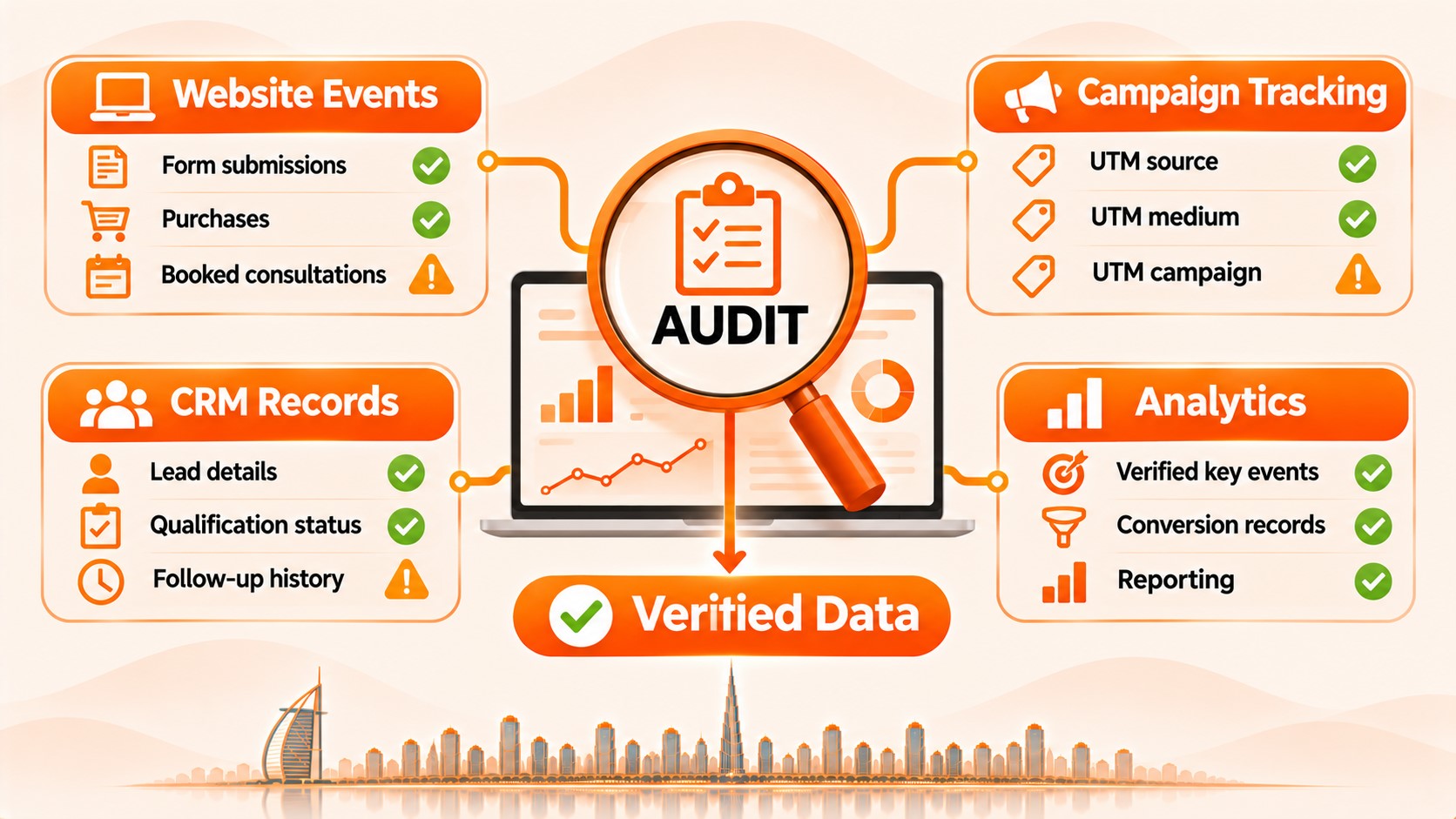
Check these common tracking points:
Form submissions, purchases and booked calls are recorded correctly.
Phone, chat and messaging enquiries are included where relevant.
Campaign tags and source names follow a consistent convention.
3. Review Website Performance and Conversion Paths
Your website is where many marketing journeys turn into enquiries or sales. Review the pages receiving the most valuable traffic, not just the homepage.
Check whether visitors can quickly understand what you offer, who it is for, why they should trust you and what action to take next. Look at mobile usability, page loading, navigation, form length, contact options and whether each landing page matches the promise made by the campaign.
A website audit should also look at the path after a visitor acts. Does the confirmation page work? Does the enquiry reach the right person? Is the next step clear? A technically successful form that nobody follows up is not a successful customer journey.

If the evidence points to page speed, confusing layouts or weak calls to action, address those issues before buying more traffic. BrandVexo's Website Development service focuses on the technical and conversion foundations of business websites.
4. Audit Paid Advertising Before Adding Spend
A digital marketing audit should examine paid advertising before recommending a larger budget. Paid advertising can generate fast feedback, but the platform's reported results do not automatically equal business results. Review campaign structure, audience and location targeting, search terms, creative, landing pages, bidding objectives and budget allocation.
Look for spend going to irrelevant searches, audiences outside your service area, overlapping campaigns or ads optimized for low-value actions. Check whether negative keywords and exclusions are appropriate. Compare campaigns using the same outcome definition and a consistent time period.
Most importantly, connect ad leads to their later outcomes. A campaign with a low cost per lead may still be weak if enquiries are unqualified or fail to become customers. A more expensive campaign may be commercially stronger if it attracts better-fit buyers.
Do not pause or scale a campaign because of one unusually good or bad day. Check whether there is enough conversion data to support a decision, and consider sales capacity, seasonality and changes in the offer.
5. Review SEO, Content and Search Visibility
An SEO review should cover more than rankings. Check whether important pages are indexed, whether the site has technical problems, whether content matches search intent and whether organic visitors take useful actions.
Use Google Search Console to review queries, pages, clicks, impressions and click-through rate. Its Search results Performance report can help identify pages with strong visibility but weak click-through, or queries that bring visitors to pages that do not meet their needs.
Review the pages that attract relevant organic traffic. Are they current? Do they answer the visitor's question? Do they link to useful service pages? Are several pages targeting the same search intent? Check whether content attracts the right audience rather than simply accumulating visits.
For a broader measurement view, compare organic traffic with qualified enquiries and sales where tracking allows. BrandVexo's Marketing Funnel Metrics guide explains how to connect channel activity with outcomes at different funnel stages.
6. Assess Social Media, Email and Lead Follow-Up
Include social media, email and follow-up in the digital marketing audit rather than treating them as optional extras. Social media should be evaluated against its role in the customer journey. Depending on the business, that may be awareness, trust, community engagement, referral traffic or direct enquiries. Review audience relevance, consistency, content quality, profile information and the actions people take after engaging.
For email, check list quality, consent, deliverability, segmentation, message relevance and the role of each sequence. A large list is not automatically an effective asset if subscribers are inactive or messages do not help people make decisions.
Then inspect what happens to leads after they arrive. How quickly does someone respond? Are enquiries assigned to an owner? Are follow-ups recorded? Can the sales team identify the source and context of each lead? A marketing channel can appear weak when the real issue is slow or inconsistent follow-up.
This is also where marketing and sales need shared definitions. Agree on what makes a lead qualified and how outcomes are returned to the people managing campaigns.
7. Compare Channels Using Commercial Outcomes
Avoid judging channels with unrelated measures. Impressions, clicks, followers and email opens can help diagnose activity, but they do not all represent the same business value.
Use a small set of comparable measures, such as qualified lead rate, cost per qualified lead, lead-to-customer rate, customer acquisition cost and revenue by source. Where customer lifetime value is reliable, consider it alongside acquisition cost rather than treating the first purchase as the entire relationship.
Audit question | Useful evidence |
|---|---|
Does the channel attract the right audience? | Audience fit and qualified lead rate |
Does traffic take the intended action? | Landing page conversion rate |
Does the lead progress? | Sales acceptance and opportunity rate |
Does the activity create value? | Customer acquisition cost and revenue |
Can the result be trusted? | Tracking tests and CRM reconciliation |

A digital marketing audit should make it easier to see which channels deserve further investigation, not force every channel into a simplistic winner-or-loser ranking. Attribution has limitations, especially when people interact with several touchpoints before buying.
8. Identify Waste, Gaps and Dependencies
Once the evidence is collected, look for patterns across channels. Common issues include duplicate software, campaigns sending traffic to weak pages, content that attracts visitors outside the target audience, untracked phone or messaging enquiries, and leads that receive no timely follow-up.
Separate symptoms from causes. A low conversion rate might be caused by poor targeting, a confusing offer, slow pages, weak trust signals or a broken form. Increasing the advertising budget will not resolve those issues. A useful digital marketing audit distinguishes problems that require more investment from problems that require better execution.
Look for recurring warning signs:
Several tools report different totals for the same conversion.
The busiest campaigns produce few qualified opportunities.
Important landing pages receive traffic but have unclear next steps.
Leads arrive but ownership and follow-up are inconsistent.
A useful review records the problem, the evidence, the likely cause, the recommended action, the owner and how success will be measured. Avoid vague findings such as “improve SEO” or “post more often.” State which page, campaign, process or measurement issue needs attention and why.
9. Turn Findings Into a Prioritized Action Plan
An audit only becomes useful when findings lead to decisions. Rank issues by expected business impact, confidence in the evidence, effort and urgency. Fix measurement failures before making channel comparisons. Resolve major conversion barriers before sending significantly more traffic. Protect campaigns that are producing valuable customers while investigating weaker areas.
Use this simple sequence:
Fix measurement first. Repair missing or duplicated events, inconsistent campaign tags and gaps between analytics and business records.
Fix high-impact customer journey problems. Address broken forms, slow priority pages, unclear offers and delayed lead response.
Improve channel efficiency. Refine targeting, search terms, creative, content and landing pages using the evidence.
Run controlled tests. Change one meaningful variable where possible and compare results over a suitable period.
Decide where more budget belongs. Increase investment only when tracking is credible, the customer journey can handle more demand and the economics support the decision.
Keep the plan realistic. A small business does not need to rebuild every channel in one month. It needs a clear order of work, named owners and a review date.
10. Decide Whether You Are Ready to Increase the Budget
You may be ready to scale when you can explain which audiences and channels produce qualified customers, trust the conversion data, understand the main conversion constraints and have enough operational capacity to handle additional demand. A final digital marketing audit review should confirm that the evidence supports expansion rather than relying on a short-term spike.
If those conditions are not met, hold the budget increase while you address the biggest uncertainty. That does not mean stopping all marketing. It means protecting effective activity while fixing what prevents you from making a sound investment decision.
Repeat a lighter review regularly and a deeper review when the business changes materially, such as entering a new market, changing agencies, launching a major offer or rebuilding the website. The point is to make budget decisions from current evidence rather than habit.
Conclusion
Increasing marketing spend should be the result of understanding performance, not a substitute for understanding it. A careful digital marketing audit helps founders check whether tracking is reliable, channels attract the right audience, the website converts, leads receive follow-up and marketing contributes to commercial outcomes. Fix the largest problems first, measure the effect and then decide whether additional investment is justified. The strongest budget decision is not always to spend more. It is to put money behind a system that can turn it into measurable business value.
Request a Growth Audit
Not sure where your marketing budget is leaking? BrandVexo can review your website, campaigns, tracking, lead journey and reporting to help identify the most important opportunities. Request an audit or consultation to discuss a practical next step.
Frequently Asked Questions
1. What is included in a digital marketing audit?
A typical review covers business goals, analytics and tracking, website performance, SEO, paid advertising, social media, email, lead handling and commercial outcomes. The exact scope should reflect the business model and the decision the audit needs to support.
2. How often should a small business audit its marketing?
A deeper review is useful before major budget increases, agency changes, market expansion or a website rebuild. A lighter quarterly review can help catch tracking, campaign and conversion issues between larger reviews.
3. Should I stop advertising during an audit?
Not automatically. Keep campaigns that are producing valuable outcomes unless there is a clear reason to pause them. The audit should identify what to protect, what to test and what to change without disrupting effective activity unnecessarily.
4. Which metrics matter most before increasing marketing spend?
Start with qualified lead rate, cost per qualified lead, conversion rate, lead-to-customer rate, customer acquisition cost and revenue by source. Select metrics that match the business model and can be measured reliably.
5. Can I conduct a digital marketing audit myself?
Yes, if you can access the relevant analytics, advertising, website and CRM data and understand how leads become customers. An independent reviewer can help challenge assumptions, identify blind spots and validate technical tracking.
6. What should I do after completing the audit?
Prioritize findings by impact and effort, assign owners, set deadlines and establish a baseline for measurement. Fix tracking and major conversion barriers first, then test channel improvements and reassess the case for more budget.
Free growth plan
Ready to grow your business?
Reading is a start — now let's build it. Tell us where you want to grow and a senior strategist will map the fastest, most profitable way to get there. Free, no obligation.
Discussion
Join the conversation
Be the first to comment. Comments are reviewed before they appear, so yours won't show up instantly — but we read every one.
Leave a comment